Melbourne's inner-city council is heading toward an open confrontation with the Allan government after a fractious Tuesday night chamber session exposed deep splits over proposed medium-density zoning changes that would allow six-storey residential buildings along key tram corridors in Fitzroy North and Carlton.
The stakes are immediate. The state government's Housing Statement, which sets a target of 800,000 new homes for greater Melbourne by 2051, requires council-level rezoning decisions to be substantially resolved by the end of the third quarter of 2026. The City of Melbourne's own planners have warned in internal briefings — circulated to councillors last month — that the municipality is currently tracking to deliver roughly 60 per cent of its assigned infill target under existing zoning. That gap is the fault line running through every council meeting right now.
Fitzroy North and Carlton in the Crosshairs
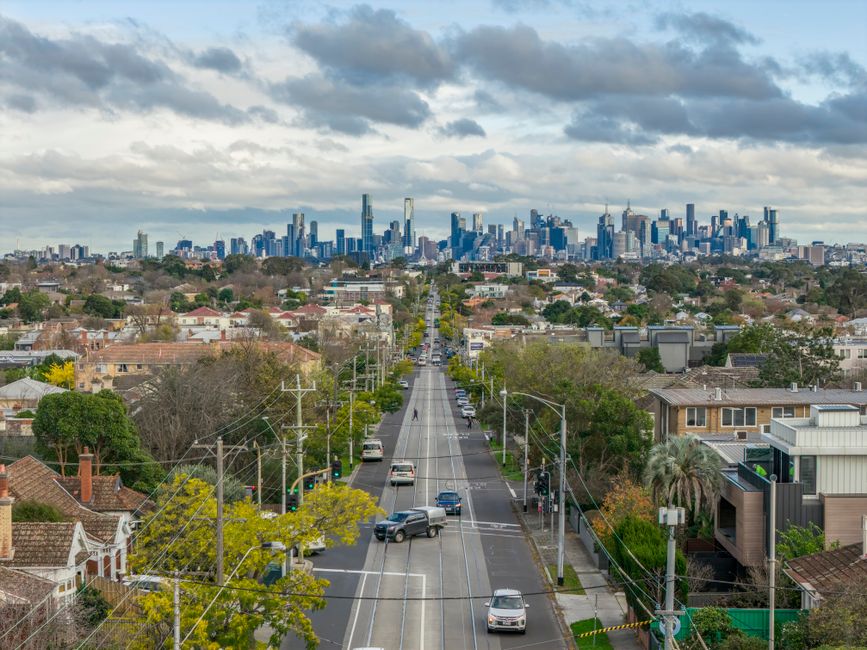
The most contested proposal would rezone a 1.4-kilometre stretch of St Georges Road in Fitzroy North and sections of Lygon Street north of Elgin Street in Carlton, permitting mixed-use residential buildings to eight storeys in some cases. Residents groups, including the Fitzroy North Residents Association and the Victorian branch of the Planning Institute of Australia, submitted conflicting positions ahead of Tuesday's session — the former calling the changes an attack on neighbourhood character, the latter arguing Melbourne cannot house its growing population without accepting density along established public transport routes.
Three councillors voted to defer any decision pending a full traffic and amenity impact study, while four backed moving the proposals to a formal exhibition period. The result: a tied procedural vote that left the council unable to advance the rezoning timetable before its August recess. The lord mayor's casting vote was not exercised, with the matter formally adjourned to a special meeting scheduled for July 22.
In the background, the CFMEU's Construction and General Division has been lobbying hard for guaranteed local labour provisions to be attached to any fast-tracked development approvals — a condition the development industry says would add $15,000 to $22,000 per apartment in construction costs, based on estimates published by the Property Council of Australia in May.
Budget Pressure Compounds the Gridlock
The council's political wrangling is unfolding against a genuinely difficult financial backdrop. City of Melbourne's 2026-27 budget, adopted in June, raised rates by 2.75 per cent — the maximum permitted under the Victorian government's rate-capping framework — while cutting $18 million from the capital works program. Funding for the Greenline project along the north bank of the Yarra River, one of the city's flagship urban renewal initiatives, was reduced by $4.3 million to $31.7 million for the financial year.
That Greenline trimming has angered Docklands and Southbank precinct groups, who argue the project is already four years behind its original 2022 completion target. The stretch from Birrarung Marr to Melbourne Museum was supposed to provide a continuous walking and cycling path through the CBD spine; as of July 2026, work between the Enterprize Park precinct and Flinders Street has been suspended pending utility relocation work.
Federal budget politics are adding another layer of complexity. Prime Minister Albanese's government earmarked $120 million in May's federal budget for urban amenity grants to capital city councils, but Victorian local governments have been told formal applications won't open until September — well after the council's August recess complicates any coordinated submission.
The July 22 special meeting is the clearest near-term moment to watch. If councillors cannot agree a path forward on the Fitzroy North and Carlton rezonings, the Allan government has indicated it retains powers under the Planning and Environment Act to intervene through ministerial amendment — an option the state has exercised twice in Melbourne's inner north in the past 18 months. Residents and community groups wanting to make formal submissions to the July 22 session have until July 14 to lodge written objections through the City of Melbourne planning portal.