Melbourne's net-zero target of 2040 looked bold when the City of Melbourne council adopted it in 2020. Six years on, the numbers tell a more complicated story. The municipality has cut corporate emissions by roughly 63 percent against a 2003 baseline, according to council reporting, but city-wide emissions — the harder figure that includes households, freight and industry — remain stubbornly above 2019 levels in two of the past three measured years.
The timing matters. Sydney's Bureau of Meteorology data confirmed this week the city recorded its hottest June since 1859, a result climate scientists are calling a structural shift rather than a weather anomaly. Melbourne's own June mean maximum sat 1.8 degrees above the long-term average, the third consecutive winter month above that threshold. The pressure on local governments to demonstrate credible action, not aspirational policy, has rarely been higher.
Where Melbourne Sits in the Global Pack
The C40 Cities network, which groups 96 major cities committed to the Paris Agreement, released its interim progress data in May 2026. Amsterdam has reduced city-wide emissions 38 percent since 2015. Copenhagen is tracking toward its 2025 carbon-neutral target and expects to reach it within months. Singapore — a useful comparison given its density, port economy and high urban heat — cut per-capita emissions 22 percent between 2018 and 2025 through mandatory building efficiency standards and a carbon tax now sitting at SGD 25 per tonne.
Melbourne, by the same C40 methodology, shows a 14 percent city-wide reduction over the same period. That figure covers the broader metropolitan area, not just the council's own operations, and it reflects the gap between what a local government controls and what it merely influences. The City of Melbourne covers 37.7 square kilometres. Greater Melbourne spans more than 9,000. The Victorian state government's policies on transport, building codes and energy supply do most of the heavy lifting — or don't.
Two programs worth watching are already producing results at street level. The Melbourne Renewable Energy Project, a power purchase agreement that now supplies renewable electricity to the Melbourne Convention and Exhibition Centre, the Melbourne Town Hall and dozens of council-owned facilities in Carlton and Fitzroy, was one of the first of its kind globally when it launched in 2018 and remains a genuine model. The Sustainable Melbourne Fund, administered through the City of Melbourne, has financed retrofits of more than 1,200 commercial buildings since 2002, cutting an estimated 380,000 tonnes of cumulative carbon.
The Problem Is Everything Outside the City Square
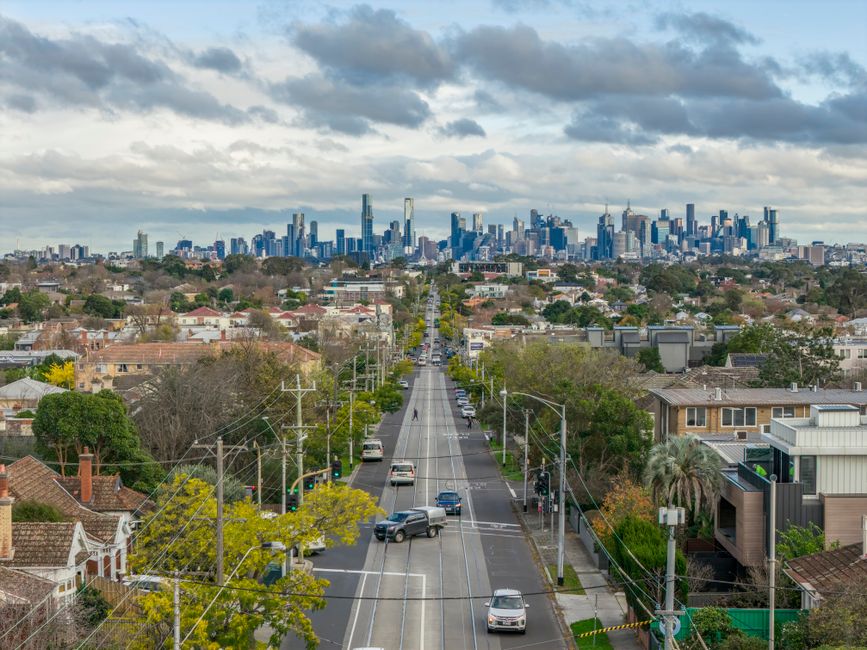
Forty kilometres north-east, the outer suburbs of Epping and South Morang illustrate the structural problem. New housing estates built under Victorian planning codes as recently as 2024 carry no mandatory all-electric appliance requirements and no minimum solar installation thresholds. Amsterdam banned new gas connections in residential construction in 2018. The Victorian government's equivalent reform — requiring new homes to be electric-ready — did not take full effect until January 2026, and enforcement has been inconsistent, according to the Environment Victoria advocacy group.
Public transport modal share is another gap. Copenhagen residents make roughly 27 percent of all daily trips by bicycle alone. In Melbourne, the 2024 Victorian Integrated Survey of Travel and Activity recorded cycling at 2.1 percent of weekday trips across the metropolitan area, unchanged from 2012. The City of Melbourne's protected lane network along Swanston Street and the Collins Street corridor has nudged inner-city cycling higher, but the Hoddle Grid represents a fraction of where most people actually live and work.
The state government's Big Build program has added 14 new Metro Tunnel stations and is mid-construction on the Suburban Rail Loop, but the first Suburban Rail Loop stage — connecting Cheltenham to Box Hill — will not open until the early 2030s at the earliest. That timeline leaves a decade where population growth and car dependence run ahead of the infrastructure meant to interrupt them.
For residents wanting to act independently of government timelines, the practical options are narrowing rather than expanding. The federal government's Household Energy Upgrades Fund, which offers low-interest loans through the Clean Energy Finance Corporation starting at 4.99 percent annually, is open to Victorian households until June 2027. Environment Victoria recommends prioritising heat pump hot water systems and electric vehicle charger installation as the two interventions with the fastest payback period in Melbourne's current energy price environment. Whether those individual choices accumulate into the system-level shift the city needs is the calculation nobody in Spring Street has yet answered convincingly.